In the machinery manufacturing and metalworking industries, annealing, normalizing, quenching, and tempering are collectively known as the "four fires" of heat treatment. From cast blanks to finished assemblies, virtually all steel components rely on these four fundamental processes. The four share a common goal: by controlling heating, holding, and cooling, they alter the internal metallographic structure of steel to optimize mechanical properties, eliminate processing defects, and adapt the material to service conditions. However, they differ drastically in heating temperature, cooling rate, cooling medium, resulting microstructure, core function, and applicable scenarios. Frontline QC inspectors, process engineers, and machinists often confuse the process logic and application scenarios of the four fires. This article dissects all four from four dimensions—process principle, key differences, specific functions, and applicable workpieces—to clearly distinguish the value of each process.
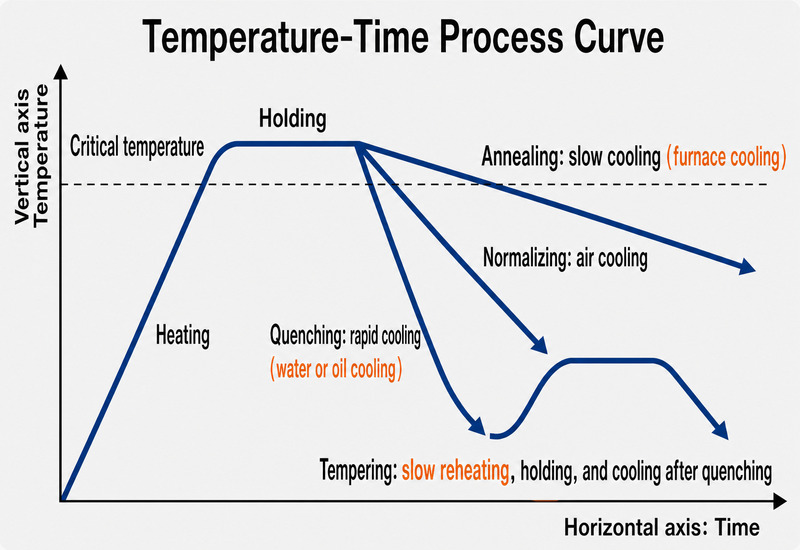
1. Two Categories of the Four Fires
Preparatory heat treatment: annealing and normalizing. Mainly used for the preliminary treatment of cast, forged, and rolled blanks. High hardness is not the goal; the focus is optimizing the material condition to pave the way for subsequent machining, finishing, and final heat treatment.
Final heat treatment: quenching and tempering. Mainly used for property-setting treatment after finishing. These processes focus on strengthening and are the core means by which components obtain high strength, high hardness, and high toughness to meet service conditions. The vast majority of load-bearing, wear-resistant, and transmission parts use the quenching + tempering combination.

At a glance:
(1) Annealing: slow cooling in the furnace; softening and stress relief; the keywords are "stable and soft"; used for blank pretreatment.
(2) Normalizing: air cooling; homogenization and property improvement; the keywords are "uniform and machinable"; a low-cost pretreatment.
(3) Quenching: rapid liquid cooling (water or oil); hardening and improved wear resistance; the keywords are "hard and strong"; very brittle if used alone.
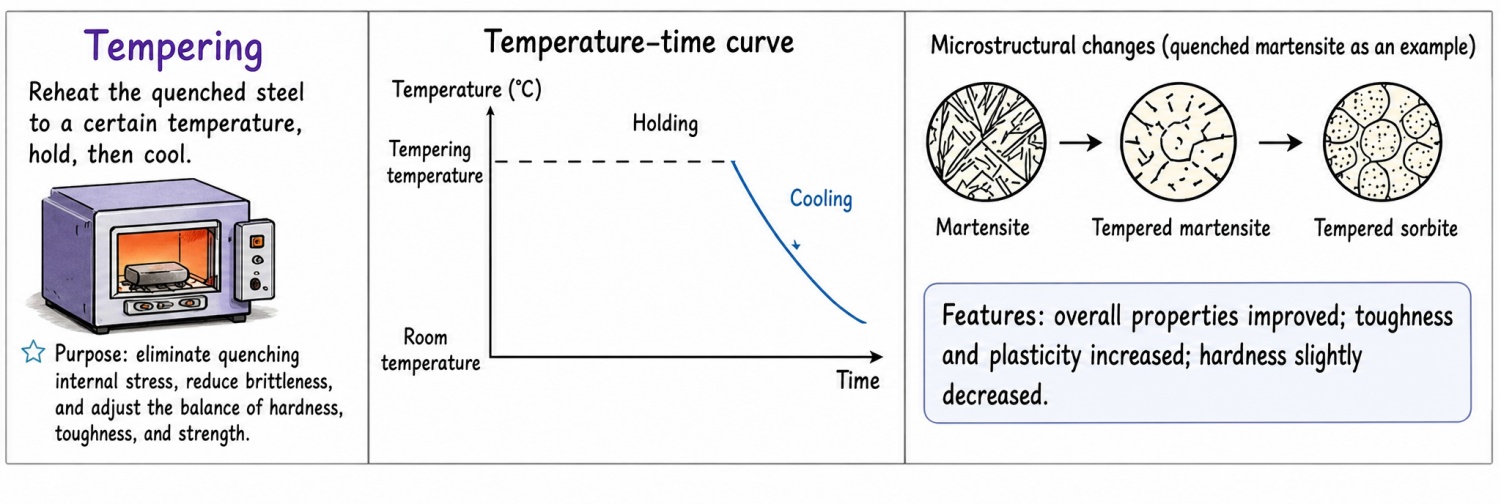
(4) Tempering: reheating, holding, and cooling at low temperature after quenching; toughness adjustment and dimensional stability; the keywords are "tough and stable"; a mandatory step after quenching.
2. Detailed Processes, Differences, and Functions
Annealing – Slow Fire Softening and Stress Relief
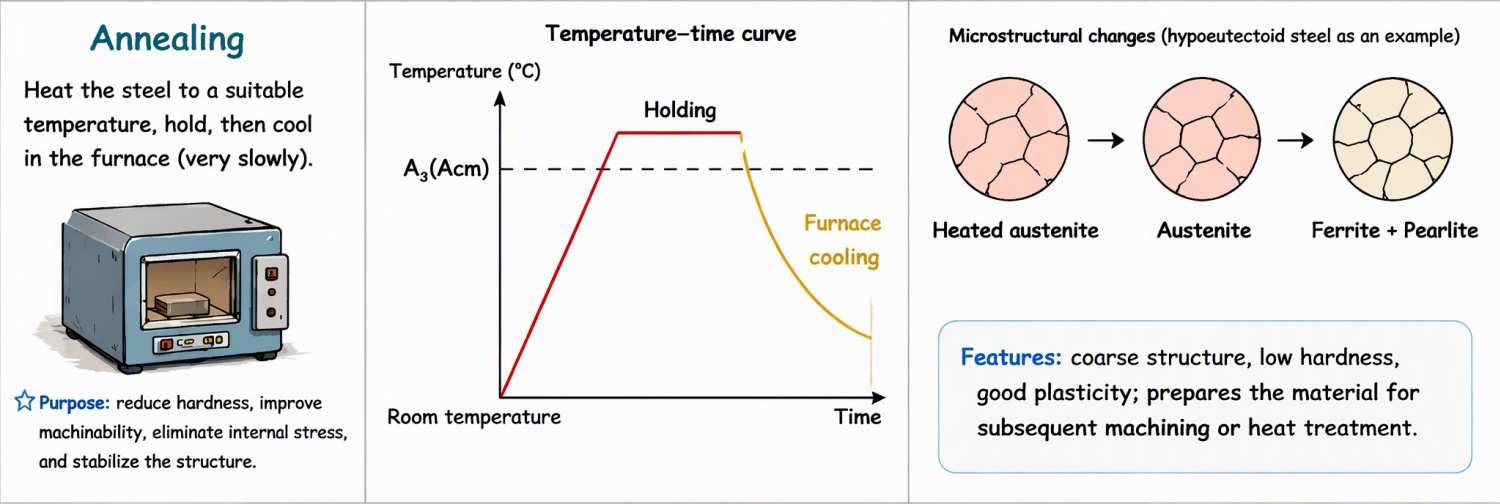
Process characteristics: The steel is heated to above (or below) the critical temperature and held long enough for uniform temperature and a stable structure throughout the workpiece, then cooled very slowly in the furnace. It is the slowest-cooling of the four processes.
Core functions:
(1) Complete elimination of residual internal stress: castings, forgings, welded structures, and cold/hot-worked parts retain significant internal stress, which can cause distortion and cracking later. Annealing fully releases the stress, stabilizes dimensions, and prevents deformation during subsequent processing and service.
(2) Grain refinement and structure homogenization: it corrects coarse grains, segregation, and porosity from casting and forging, making the internal structure uniform and laying a sound foundation for subsequent heat treatment.
(3) Softening and hardness reduction: it eliminates work hardening and improves machinability, avoiding excessive tool wear, burrs, and poor surface finish.
Applicable scenarios: heavy cast/forged blanks, welded structures, hard-to-machine steels, and precision workpiece blanks requiring long-term dimensional stability.
Normalizing – Air Cooling for Homogenization, a Cost-Effective Pretreatment
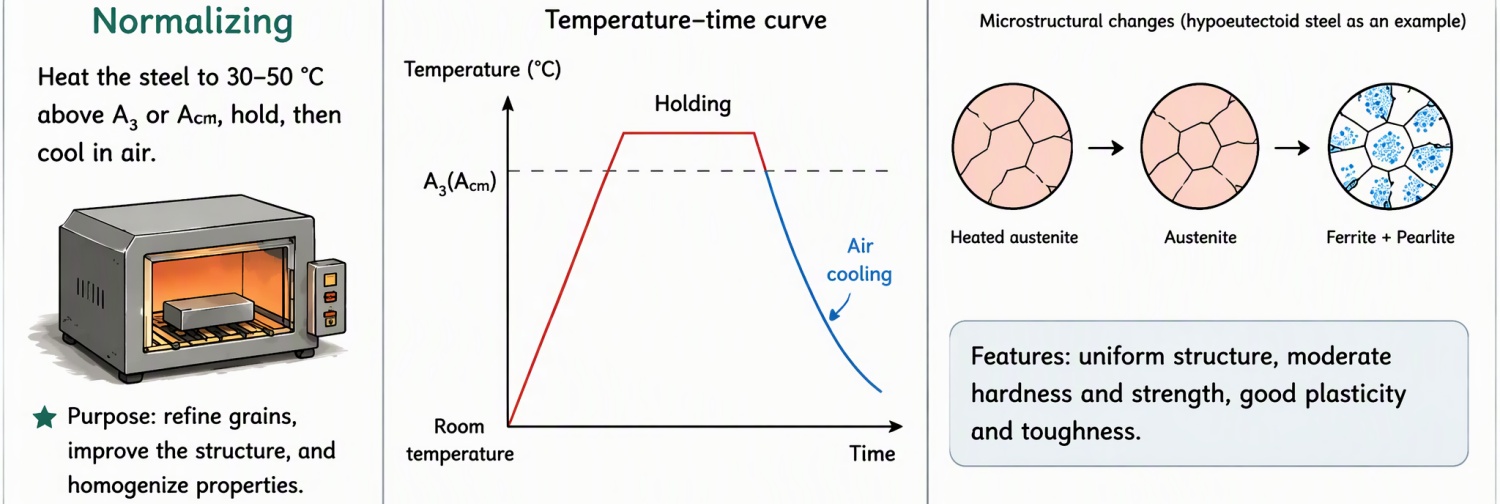
Process characteristics: the heating temperature is higher than that of annealing (typically 30–50 °C above Ac3 or Acm). After holding, the workpiece is removed and cooled naturally in air—faster than annealing but slower than quenching—giving uniform cooling with higher efficiency and lower cost.
Core functions:
(1) Grain refinement and homogenization: the faster cooling produces a finer microstructure than annealing, significantly improving strength and toughness and optimizing overall mechanical properties.
(2) Hardness adjustment for machining: the blank hardness is adjusted into the machinable range, avoiding burrs and poor surface finish.
(3) Elimination of network defects: it removes network cementite and banded structures inside the steel, preventing cracking and uneven properties in subsequent heat treatment.
Applicable scenarios: pretreatment of plain carbon and low-alloy steel blanks; a simplified, lower-cost alternative to annealing; preliminary treatment before quenching-and-tempering of simple, small-to-medium structural parts.
Quenching – Rapid-Fire Hardening for High Hardness
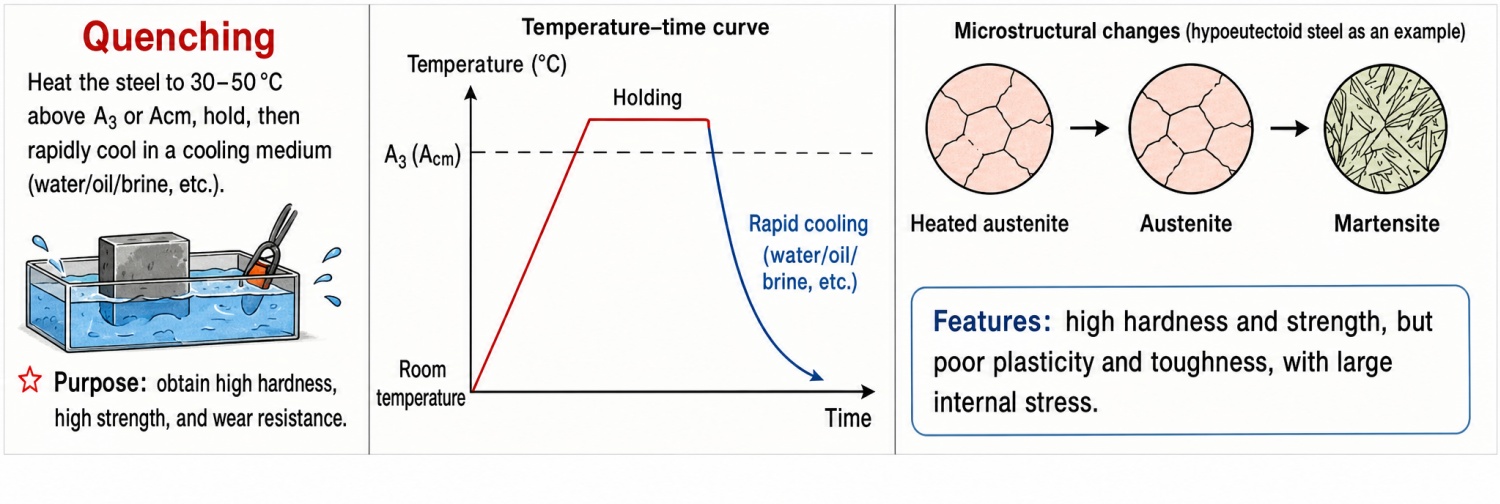
Process characteristics: the steel is heated to the austenitizing temperature (30–50 °C above Ac3 or Acm), held, and then rapidly immersed in water, oil, or quenchant for the fastest cooling of the four processes. The drastic transformation produces a high-hardness martensitic structure.
Core functions:
(1) High hardness and strength: quenching dramatically increases hardness to meet high load-bearing requirements.
(2) Improved wear resistance: the martensitic structure provides excellent wear resistance for high-friction service conditions.
Shortcoming: after quenching, the workpiece is extremely brittle with very low toughness and large quenching stress; used directly it will easily chip or fracture, and dimensional stability is poor. It must never be the final process on its own and must always be paired with tempering.
Applicable scenarios: hardening of semi-finished mechanical parts requiring high hardness, wear resistance, and high strength; the core strengthening step for precision wear parts such as gears, shafts, dies, and cutting tools.
Tempering – Stabilizing Fire for Toughness and Final Properties
Process characteristics: a dedicated companion process after quenching. The hardened workpiece is reheated below the critical temperature, held, and air-cooled. Depending on temperature, it is classified as low-temperature, medium-temperature, or high-temperature tempering, each producing different property adjustments.
Core functions:
(1) Eliminating quenching stress and brittleness: it fully releases residual quenching stress, removes brittleness, prevents cracking and distortion, and solves the "hard but brittle, prone to fracture" problem of quenched parts.
(2) Precise property tuning: by selecting the tempering temperature, an optimal balance among hardness, strength, and toughness is achieved for different service conditions.
Applicable scenarios: low-temperature tempering retains high hardness and wear resistance, for cutting tools, bearings, and dies; medium-temperature tempering provides high elasticity and fatigue resistance, for springs and elastic components; high-temperature tempering provides a good combination of overall mechanical properties and, together with quenching, forms quenching-and-tempering (QT) treatment, used for load-bearing structural parts such as shafts, gears, and connecting rods.
Conclusion
The "four fires" of heat treatment form a progressive, mutually complementary process system that runs through the entire manufacturing workflow of metal workpieces. Distinguishing clearly their process characteristics and functions is fundamental knowledge for process engineers, quality inspectors, and production managers, and is the key to controlling heat treatment quality, preventing cracking and distortion, and extending product service life.
author:Kaiquan Dai